


Phylum: Arthropoda Lar, 1904
Subphylum: CrustaceaBrünnich, 1772
Classe: Malacostraca Latreille, 1817
Ordine: Decapoda Latreille, 1802
Famiglia: Penaeidae Rafinesque, 1815
Genere: Fenneropenaeus Pérez Farfante, 1969
English: Indian prawnugela prawn, White prawn, Banana prawn, Indian banana prawn
Français: Crevette blanche des Indes, Crevette royale blanche
Descrizione
Cresce fino a 228 mm e ha una durata di vita di 18 mesi. Dopo la schiusa, si ottengono naupli che nuotano liberamente, che passano ulteriormente attraverso protozoi, mysis e poi allo stadio postlarvale, che assomiglia al gambero adulto. Le postlarve migrano verso gli estuari, si nutrono e crescono fino a raggiungere una lunghezza di 110-120 mm, e questi subadulti tornano in mare e vengono reclutati nella pesca. È anche comunemente usato nell'allevamento di gamberi.
Diffusione
Si trova nell'Indo-Pacifico occidentale dall'Africa orientale e sud-orientale, attraverso India, Malesia e Indonesia fino alla Cina meridionale e all'Australia settentrionale.
Sinonimi
= Cancer vocans Linnaeus, 1758 = Gelasimus cultrimanus White, 1847 = Gelasimus marionis Desmarest, 1823 = Gelasimus nitidus Dana, 1851 = Ocypode citharoedicus Say, 1817 = Uca marionis f. excisa Nobili, 1906 = Uca vocans Linnaeus, 1758.
Bibliografia
–"Fenneropenaeus indicus (H. Milne Edwards, 1837)". Integrated Taxonomic Information System.
– "Fenneropenaeus indicus". Aquaculture Compendium. CAB International. Archived from the original on July 19, 2011.
–"Fenneropenaeus indicus Indian white prawn". SeaLifeBase. Retrieved May 27, 2010.
–"Banana prawn". Seafood Services Australia. Archived from the original on September 13, 2009.
–"Penaeus indicus". Species fact sheet. Food and Agriculture Organization. Retrieved September 15, 2010.
–The state of world fisheries and aquaculture 2008. Food and Agriculture Organization.
–"Greenpeace International Seafood Red list". Greenpeace. Archived from the original on April 10, 2010.
–V. N. Pillai; N. G. Menon (eds.). "Seed production and hatchery management of Penaues indicus". Marine Fisheries Research and Management. Kochi, India: Central Marine Fisheries Research Institute.
–P. A. A. T. Jayawardene, D. M. McLusky & P. Tytler (2002). "Reproductive biology of Penaeus indicus (H. Milne Edwards, 1873) from the Western Coastal waters of Sri Lanka". Asian Fisheries Science. 15 (4): 315-328.
–Sadaharu Makinouchi & J. Honaculada-Primavera (1987). "Maturation and spawning of Penaeus indicus using different ablation methods". Aquaculture. 62 (1): 73-81.
–Medina N. Delmendo (1989). "Some advances attained in shrimp farming research and management practices: insights to future prospects for expansino of production". Manila, Philippines: ASEAN/UNDP/FAO Regional Small-Scale Coastal Fisheries Development Project.
–W. D. Emmerson (1980). "Induced maturation of prawn Penaeus indicus" (PDF). Marine Ecology Progress Series. 2: 121-131.
–A. Laxminayana; S. M. Pillai; K. K. Surendran; C. S. Sasidharan, eds. (1995). Backyard hatchery technology for the white prawn, Penaeus indicus (PDF). CIBA Bulletin No. 8. Madras, India: Central Institute for Brackishwater Aquaculture.
–Metin Kumulu (1998). "Larval growth and survival of Penaeus indicus (Decapoda: Penaidae) on live feeds" (PDF). Turkish Journal of Biology. 22: 235-245.
–K. Alagarswami. "Prospects of coastal aquaculture in India" (PDF). CMFRI Bulletin. 30: 83-87.
–R. U. Young (1987). "Prevalent technical problems in semi-intensive culture of Penaeus monodon in Philippines".
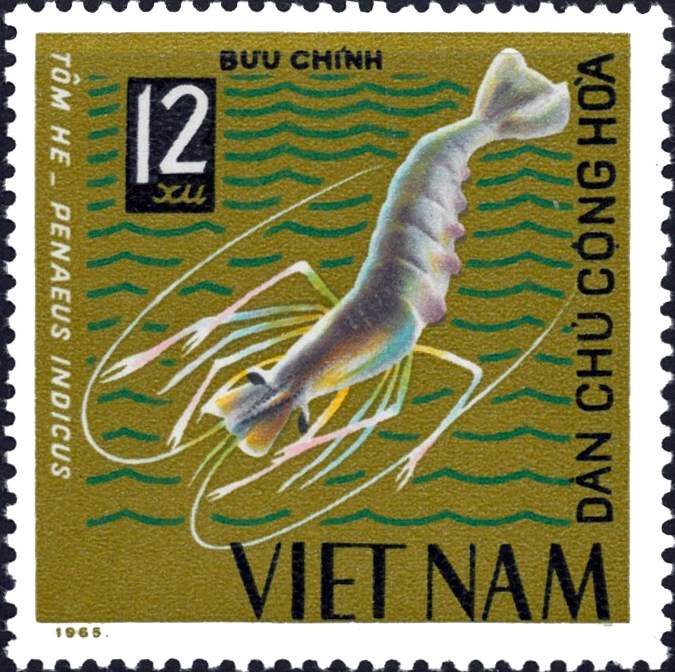
|
Data: 01/01/1965
Emissione: Vita nel mare Stato: Vietnam (North) |
|---|
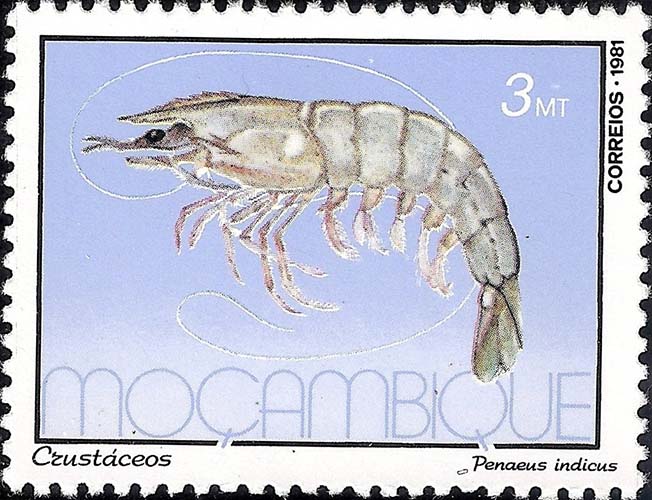
|
Data: 06/12/1981
Emissione: Crostacei Stato: Mozambique |
|---|